The first sign is usually small. A large grant goes out in late December before anyone calls the CPA, or a board meeting ends with three opinions and no decision. Once those moments start stacking up, family foundation management deserves a harder look, because the foundation may have outgrown the people running it on nights and weekends.
For many families, the shift starts with education. A foundation that began with one gift to a child's independent school ends up funding scholarships, tuition assistance, and a capital campaign. Families who already work with scholarship-granting organizations know how quickly the paperwork follows.
Generosity is easy to start. Keeping it organized for twenty years takes a process.
TL;DR Quick Answers
Family foundation management and philanthropic planning services
Family foundation management keeps a private foundation compliant and organized. Philanthropic planning services decide what the family gives, through which vehicles, and how that giving fits the tax and estate plan. Both work best under one coordinated team.
What management covers: Form 990-PF filings, the 5 percent annual payout, grant tracking, clean records, and board support.
What planning covers: Giving priorities, the choice between a foundation, donor-advised fund, or charitable trust, and gift timing coordinated with your CPA.
When to bring in help: Once compliance, grant volume, or family decisions outgrow the board's time. Many families reach that point around $1 million in annual grants or 25 active grantees.
Who keeps control: The family board still sets the mission and approves every grant.
Who gives legal and tax advice: Your attorney and CPA remain the technical experts. A Family Office coordinates the strategy and makes sure it gets carried out.
Top Takeaways
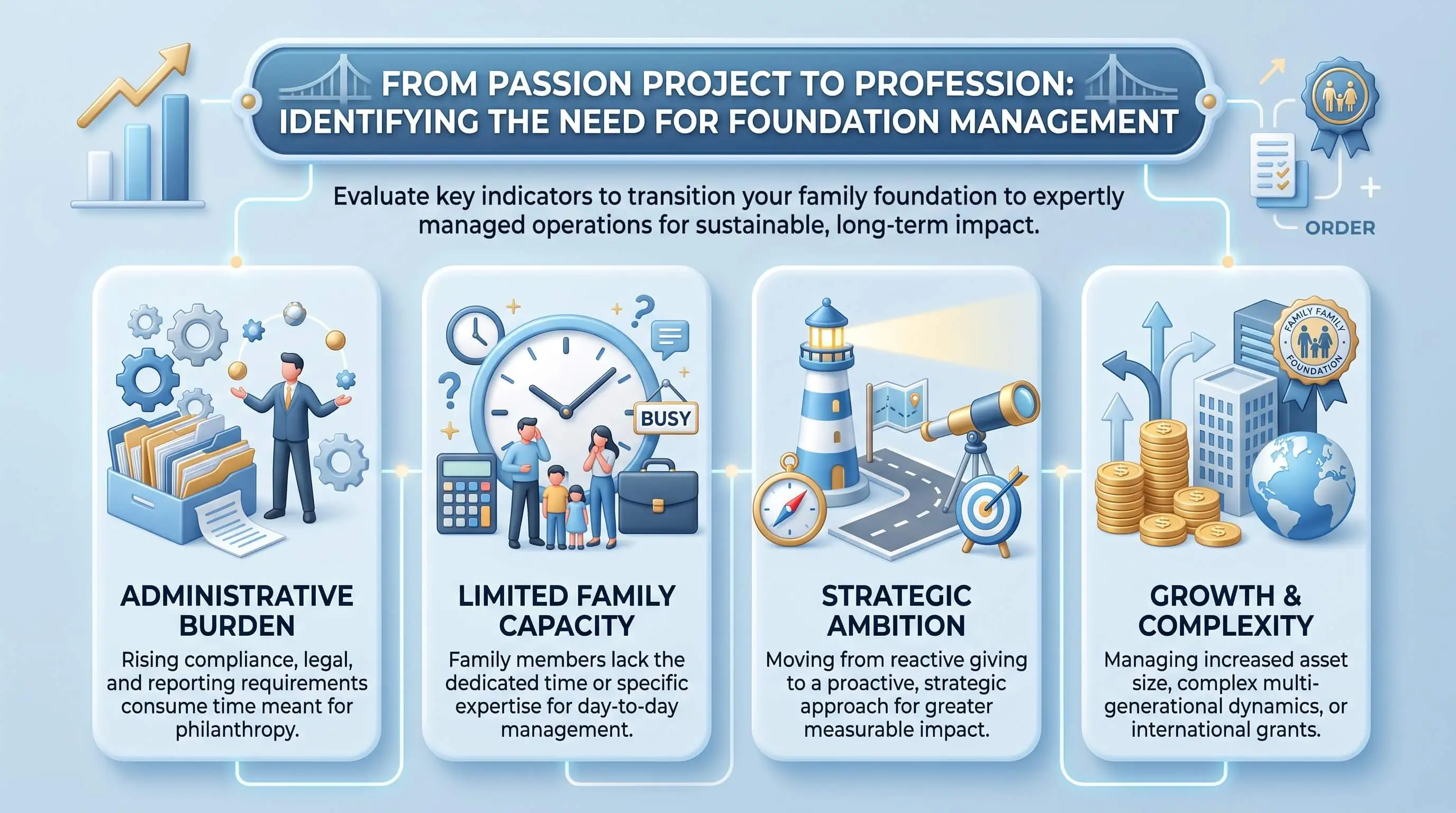
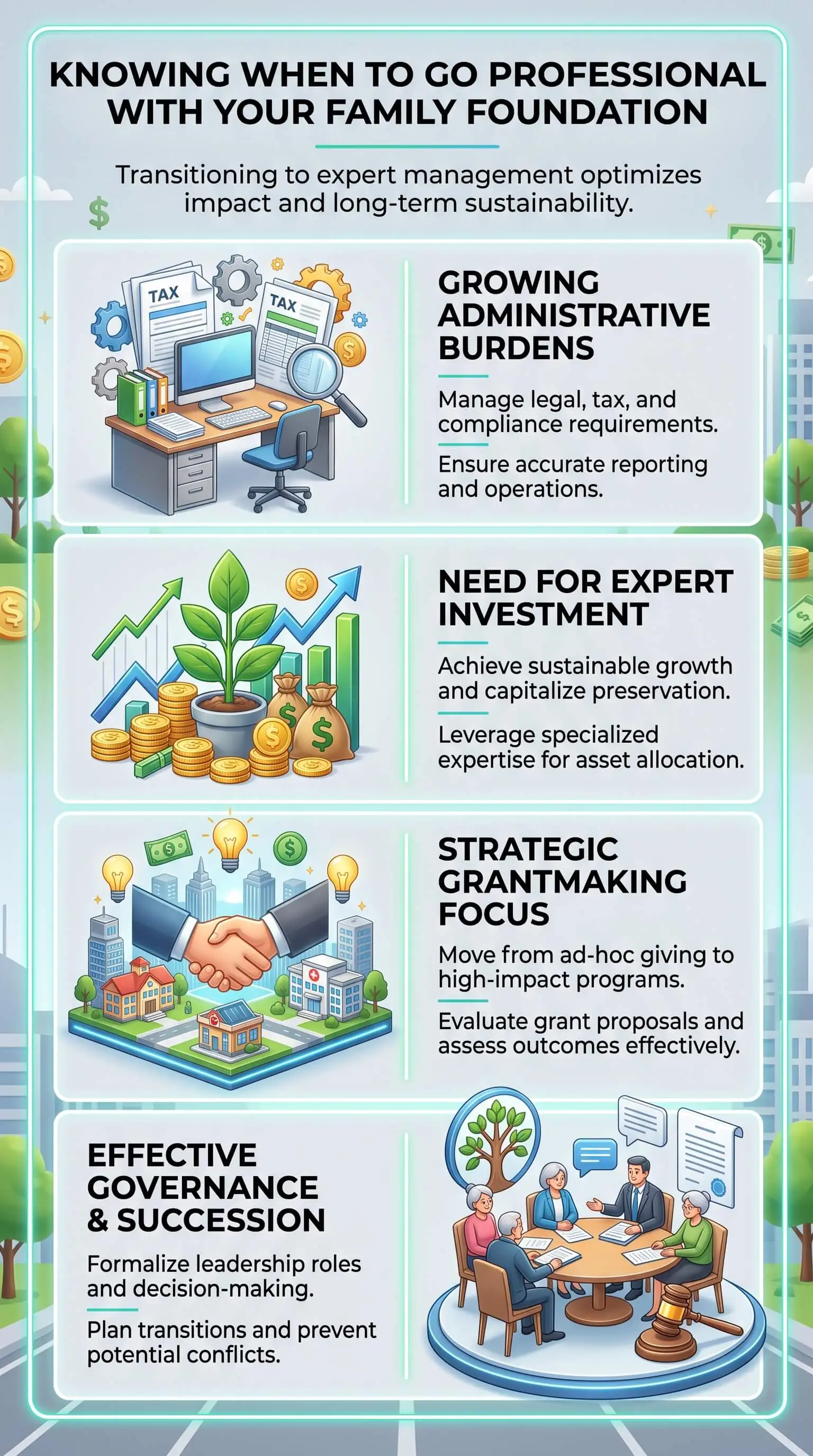
A family foundation needs professional management once compliance, grants, records, or family decisions outgrow the board's time and expertise.
Missing the annual payout costs a 30 percent IRS excise tax on the shortfall, and 100 percent more if it isn't fixed.
Roughly $1 million in annual grants or 25 active grantees is when many families bring in help, though a scholarship program can get you there sooner.
Tie foundation work to your tax and estate plans now, and bring the next generation in before they inherit a board seat.
What Family Foundation Management Really Involves
Running a family foundation means handling tax filings and payout rules, grant decisions, records, investments, and the board itself. The giving is the part families enjoy. Family foundation management and philanthropic planning services can take on much of the administrative and planning work. The rest is what keeps the foundation in good standing with the IRS.
When one person carries all of it, something slips. Usually it's the paperwork nobody notices until a filing is due.
7 Signs Your Family Foundation Has Outgrown Informal Management
1. Compliance happens at the last minute
If Form 990-PF and the annual payout calculation get pulled together in a rush every spring, pay attention. A foundation that misses its required distribution owes a 30 percent excise tax on the undistributed income. Leave it uncorrected and the IRS adds a 100 percent tax on top.
2. Grant volume has outgrown the process
A spreadsheet can handle five gifts a year, but it starts to buckle somewhere around forty. Philanthropy advisors often point to roughly $1 million in annual grants or about 25 active grant partners as the stage when families bring in staff or outside help.
3. Scholarship programs are growing
Education-focused foundations carry extra rules. Scholarships paid to individual students must follow grantmaking procedures the IRS approves in advance, with objective selection and ongoing supervision. We've seen families learn this only after their first awards went out.
4. Records live in inboxes and shoeboxes
Gift acknowledgments, grant agreements, and board minutes should take minutes to find. If pulling last year's records eats a weekend, the foundation needs a system and someone who owns it.
5. Giving runs separately from tax and estate planning
The foundation's calendar and the family's tax calendar should talk to each other. When they don't, contributions land in the wrong year and structures stop matching the estate plan.
6. The family disagrees on priorities or who decides
Some disagreement is healthy, but when the same argument returns at every meeting, the board needs structure. A written mission, a grant policy, and clear voting rules keep the conversation on impact rather than personalities.
7. The next generation is stepping onto the board
Adult children often inherit board seats with no preparation at all. Building education and a clear process into that handoff is how a foundation outlasts its founders.
Your Options: In-House Staff, Foundation Management Firms, or a Family Office
Larger foundations tend to hire an executive director and program staff. Smaller ones often outsource filings, grant processing, and records to a foundation management firm.
A family office takes a wider view. It manages the family's whole financial picture, so foundation work connects directly to tax strategy, estate planning, and wealth transfer. A Family Office that offers philanthropic planning services can bring investment-level discipline to giving by coordinating the vehicles your family uses and keeping records clean year-round. Your legal and tax professionals remain the technical experts.
Some families are better served by something simpler. A donor-advised fund carries on a family's giving with far less administration than a private foundation, and that's a perfectly good answer.
Here's how the two approaches usually compare:
Compliance: Founder-led foundations tend to file near deadlines. Professionally managed ones track filings and payouts all year.
Grantmaking: Relationship-driven giving works until the grant list grows. A written policy and review process keep it consistent.
Records: Scattered email and paper files give way to organized, audit-ready documentation.
Tax and estate coordination: Occasional check-ins with the CPA and attorney become year-round coordination.
Succession: Instead of leaving the handoff to chance, the next generation is prepared and involved early.
"Families rarely call us because they've stopped caring about their foundation. They call because they care about it and can see the details slipping. The turning point is usually one missed step, like a December gift made without the CPA in the loop, or a scholarship program that launched before anyone read the IRS rules. Once the records and the calendar are in order, board meetings go back to being about impact. Our job is coordination. The family's attorney and CPA stay the technical experts, and we make sure the plan actually gets carried out."
7 Essential Resources
If a new board member asked us where to start reading, this is the list we'd hand them.
IRS: Private Foundation Annual Return. Covers who files Form 990-PF, the May 15 due date for calendar-year foundations, and the daily late-filing penalties.
IRS: IRC Section 4945(g) Individual Grants. Read this before your foundation pays a single scholarship directly to a student.
NCFP Guide to Understanding Operating Models. The National Center for Family Philanthropy lays out the ways families staff and run their giving.
NCFP Guide to Conflict in Family Philanthropy. Useful for any board that keeps circling the same argument.
NCFP Guide to Engaging Next-Generation Adults. How to give adult children real roles instead of ceremonial seats.
Exponent Philanthropy Foundation Operations and Management Report. Staffing, governance, and cost benchmarks for foundations with few or no staff.
Philanthropy Roundtable: Private Foundations and the 5 Percent Payout Rule. A plain explanation of the minimum distribution rule, with a worked example of what a shortfall costs.
Supporting Statistics
71 percent of family foundations have paid staff. Exponent Philanthropy's 2026 Foundation Operations and Management Report surveyed foundations with few or no staff and still found most families paying for some help.
60 percent of family foundations seat next-generation members on the board. The same 2026 Exponent Philanthropy report found 71 percent actively involve the next generation. For most boards, succession is already happening.
U.S. foundations gave an estimated $117.15 billion in 2025. That's up from about $60 billion in 2010 after adjusting for inflation, according to Giving USA 2026 data summarized by Give.org. Bigger foundations draw closer scrutiny.
With more family foundations using paid support, involving the next generation, and managing larger pools of charitable capital, outsourced family office executive services can help families strengthen governance, coordinate succession, and manage the growing administrative demands behind their philanthropy.
Final Thoughts
The most common worry we hear about family foundation management is that outside help means giving up control. In practice, the opposite happens. Once filings, records, and grant tracking run on a schedule, the board gets its time back for the decisions only the family can make.
A foundation built around one scholarship fund can turn into a multi-program operation within a decade. The families who handle that growth well tend to admit early that good intentions need a good process, and they build one before the IRS or a family dispute forces the issue.
So if three or more of these signs sound familiar, read it as good news. Your foundation is working, and it's ready for structure that will help it last.
Frequently Asked Questions
What does family foundation management include?
It covers tax filings and payout calculations, grantmaking, recordkeeping, investment oversight, and board governance. Some families do all of it themselves. Others hand the administration to staff, a foundation management firm, or a Family Office and keep grant decisions in the family, much like they may rely on expert guidance when choosing the best private school for the next generation.
At what size should a family foundation hire professional help?
No law sets a threshold. Many advisors point to about $1 million in annual grants or 25 active grantees. Complexity matters as much as size, so a small foundation running a scholarship program may need help first.
Can our family keep control of grant decisions with outside management?
Yes. The board still sets the mission and approves every grant. Outside support handles the process around those decisions, like documentation, compliance, and coordination with your CPA and attorney.
What's the difference between a family office and a foundation management firm?
A foundation management firm runs the foundation. A family office looks at the family's entire financial life, which lets it connect giving to tax strategy and the estate plan.
Is a donor-advised fund easier than a private foundation?
Usually. The family skips the annual 990-PF and most of the administration. In exchange, it gives up some control over investments, staffing, and certain kinds of grants.
What do philanthropic planning services cover?
They help a family set giving priorities, choose the right vehicles, from foundations and donor-advised funds to charitable trusts, and coordinate that plan with its legal and tax advisors. Good planning also leaves behind documentation and a repeatable process the next generation can pick up.
Get Support With Philanthropic Planning Services
Take these seven signs to your next board meeting and count how many fit. If it's three or more, talk with an advisor offering multi-family office wealth management services to coordinate your family’s wealth, philanthropy, tax planning, and long-term financial priorities alongside your CPA and attorney. Schedule a private consultation and start building a giving framework your family can carry forward.